


Hi my fellow lab rats,
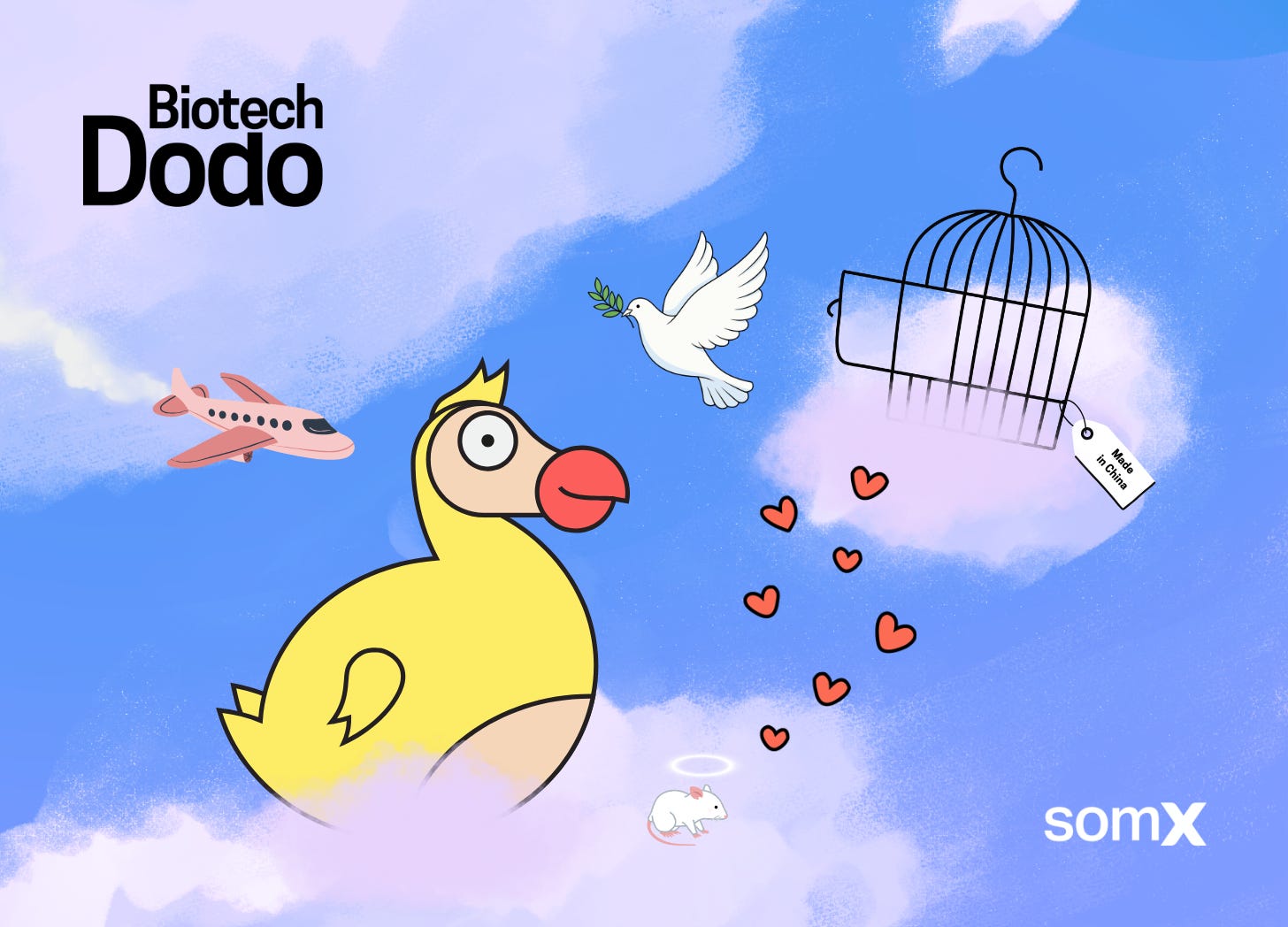
This week, Swedish researchers break free of biological constraints with artificial heart muscle made from conductive plastic, SMArT liberates CRISPR from its genomic baggage filtering dangerous edits before they reach patients, Osaka scientists unleash tomato-picking robots, Chinese biotech escapes its discount-era pricing, and the FDA releases cancer drug development from mandatory animal testing.
Free at last,
Dodo
If there’s anything you’d like to see in future editions of Biotech Dodo, send us a message.
Discover 🔍
🫀 Scientists create conductive plastic to replicate heart muscle cells (Bioengineer.org): Researchers at Linköping University, led by Simone Fabiano, have built an artificial cardiomyocyte from conductive polymers, the first contraption to recreate the slow calcium channel dynamics that drive cardiac contraction. Published in Nature Communications, the device handles both ionic and electronic conductivity, paving the way for biocompatible pacemakers, sensors for cardiac disturbances, and implants for muscular dystrophy or nerve injury.
Our take: Fabiano’s gang previously built artificial organic neurons emulating sodium and potassium channels. The cardiomyocyte adds slow calcium kinetics, a rather thornier piece of biology inorganic electronics have never got the hang of. Linköping is methodically working through the body’s electrically excitable cell types in plastic, a rather more ambitious programme. The commercial path seems to be bioelectronic medicine, in which polymers sidestep silicon’s immune-related issues.
🧬 New SMArT platform improves safety of CRISPR gene editing (News Medical): Edited blood stem cells can now be enriched to near-purity, thanks to SMArT, a CRISPR add-on built by Luigi Naldini’s San Raffaele Telethon group. The platform uses transient synthetic AND-gate reporters to hoover out cells carrying potentially harmful genomic alterations. The most advanced version uses a single CRISPR regulatory system to detect correct integration and switch on genes that may improve stem cell engraftment.
Our take: Two earlier sickle cell trials were paused after patients developed myeloid malignancies, traced to cytotoxic conditioning or insertional mutagenesis from lentiviral vectors. CRISPR was meant to be the cleaner alternative by editing in situ, though the risk simply migrated, with large deletions and chromosomal rearrangements from Cas9 cuts emerging as the new bogeyman. SMArT concedes the field couldn’t engineer those out and built a sorting system to find the survivors.
🍅 Scientists develop virtual tomato training arena for agricultural robots (Phys.org): 3D Gaussian splatting and Unreal Engine 5, more commonly the domain of video games, have been put to work generating synthetic training data for tomato-picking robots. The virtual farm, built by Takuya Fujinaga’s team at Osaka Metropolitan University, automatically produces images and YOLO-formatted labels for AI vision systems, sidestepping the slog of hand annotation, with plans already underway to extend the approach to other crops.
Our take: The bottleneck in agricultural AI isn’t the hardware these days – robots can already pick tomatoes at 86.7% accuracy, and the kit has been steadily improving for years. The constraint is the vision system telling them which one to pick, and those systems run on labelled training data that farms have been paying humans to produce, season after season. A virtual farm doing that labour for free should generalise across crops.
🇨🇳 No longer a bargain pool, Chinese biotechs command higher premiums (BioSpace): Total deal value for China-developed assets has risen to $10.1B so far this year, a sharp escalation from previous discount-driven dynamics. Eli Lilly leads as the most aggressive buyer with over $13B committed since March 2025. Platform deals are replacing single-asset licensing as the dominant transaction model, and Chinese biotechs are increasingly demanding upfront payments closer to those of comparable US counterparts.
Our take: The bargain bin has closed. Royalty rates on Chinese deals have settled at the 10-13% range now standard for these deals, with single-digit royalties largely vanished. Astellas-Hutchmed was the last big single-digit deal, and rates that had previously sunk to 2-3% are gone for good. The economics have reset entirely, leaving Western buyers paying more upfront and more in perpetuity, changing the calculation for anyone still treating China as a value play.
And finally…
🐭 FDA ends mandatory animal testing for cancer therapeutics effective June 2026 (GeneOnline News): Draft guidance issued on 29 May proposes to reduce animal testing in nonclinical safety studies for oncology biologics and conjugated products, with public comments open until 30 July. The guidance builds on FDAMA 2.0, which removed the blanket animal-testing mandate in 2022, and supplements existing ICH and FDA frameworks. It signals the agency’s broader push to embrace new approach methodologies, including organs-on-chips and in silico modelling.
Our take: Animal models have less than 8% correlation with human clinical trial outcomes in oncology, which makes preclinical mouse testing in cancer not so much ethically uncomfortable as scientifically rather suspect. The FDA isn’t being kind – it’s catching up. Mouse xenografts have failed to predict human cancer responses for decades, and the draft guidance simply acknowledges what every oncology developer has known for years. From one Dodo to a great many laboratory pals, this bird says good riddance.
Tune in 🎧
🦠 Why the Ebola Outbreak Has Been Nearly Impossible to Stop: NYT Africa correspondent Declan Walsh reports from the epicentre of one of the worst Ebola outbreaks in history, examining why under-resourced health workers are struggling to contain its spread.
⌛ The past, present and future of DNA science: Professor Turi King traces DNA science from forensic fingerprinting to medical screening, and what her book reveals about the secrets genetics has yet to unlock.
🧠 Outside of Our Minds: Anthropologists, historians, and a brain-computer interface researcher trace how humans have externalised thought from stone carvings to AI, and where the next frontier of communication may lead.
Apply ✍️
🥼 Senior lab Technician, Portal Biotech: Think you could keep a single-molecule protein sequencing platform stocked, safe, and shipshape? You'll own reagent prep, inventory, equipment servicing, and lab operations that are scaling quickly toward a global product launch.
🎬 Associate Director Safety Sciences, BioNTech: Got a forensic eye for emerging safety signals in oncology? You'll oversee safety surveillance, author DSURs and Risk Management Plans, contribute to regulatory submissions, and act as Subject Matter Expert.
⚙️ GMP Production Biotechnologist, OXB: Ready to get hands-on with viral vector manufacture at one of gene therapy's original pioneers? You'll lead GMP processes, act as SME for SOPs and batch documentation, and train others across lentivirus, AAV, and adenoviral programmes.
RSVP 📆
🖥️ 08–12.06 | London Tech Week | London, UK: Europe’s premier tech gathering – drawing innovators, investors and enterprise leaders to hear from the likes of OpenAI, Anthropic, Isomorphic Labs and the UK government on what’s next in tech.
🔬 10–12.06 | BioInference 2026 | St Andrews, UK: A three-day academic conference at Scotland’s oldest university, bringing together statisticians and biologists to tackle inference problems across epidemiology, genomics, spatial omics, and mathematical biology.
🤑 15.06 | Capital For Cures Liquidity Event – Royalty Financing | Amsterdam, Netherlands: This networking and panel event brings together investors, family offices and biotech innovators to discuss royalty financing, with a focus on how non-dilutive capital can fund breakthroughs while preserving long-term value.
🩺 15–18.06 | HLTH Europe 2026 | Amsterdam, Netherlands: Europe’s biggest healthcare innovation gathering hauls 5,000+ leaders to Amsterdam, with one in three at C-suite level, to thrash out the continent’s particular healthcare headaches and opportunities.
Got news, jobs or events you think are worth coo-ing over? Post an event here, or email us at biotechdodo@substack.com!

We’re SomX – a communications and creative agency trusted by biotech, pharma and healthtech pioneers. We craft strategy, content, PR and design that translate complex biology into compelling stories and investor‑ready excitement. Get in touch to amplify your science beyond the lab bench.