


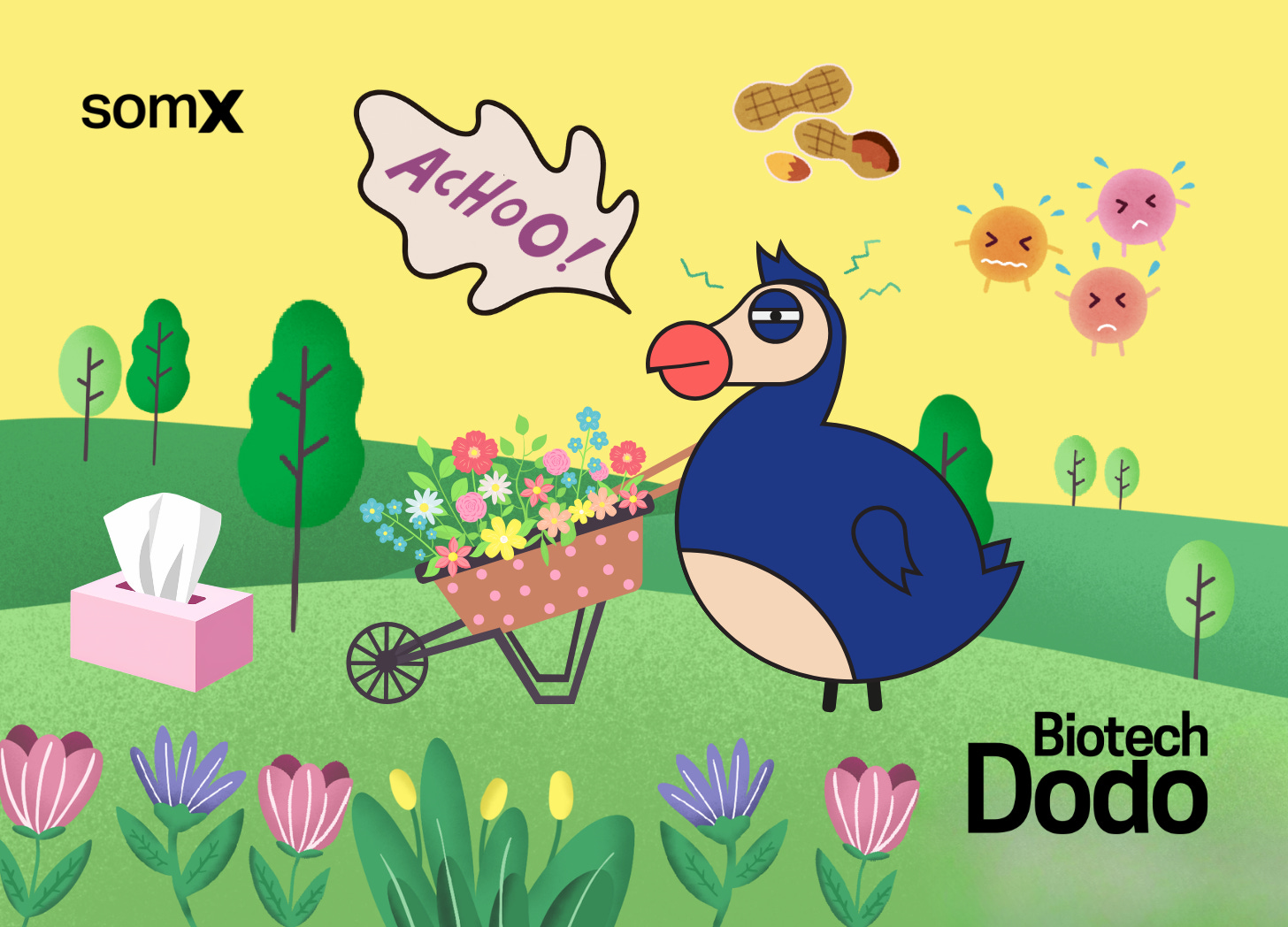
Hello, my fellow allergy sufferers,
With pollen counts rising and allergy season well underway, this week’s news arrives just in time: Pfizer has had a nasty reaction to its CD47 bet, Big Pharma gets a whiff of Asia’s ageing wave, Switzerland’s biotech sector is positively blooming, Scarlet Therapeutics raises £3.2M, and McGill researchers zap peanuts with cold plasma – reducing their allergenicity by 69%.
Pass the antihistamines,
Dodo
If there’s anything you’d like to see in future editions of Biotech Dodo, send us a message.
Discover 🔍
❌ Pfizer’s $2.3B bet ends in failure as CD47 blocker scrapped (Fierce Biotech): The 2021 Trillium acquisition handed Pfizer a pair of CD47 inhibitors – ontorpacept and maplirpacept – built on the rather appealing notion of teaching macrophages to gobble up cancer cells. Ontorpacept made it to a Phase 2 study for soft tissue cancers, but was binned last year. Maplirpacept has now followed suit, after Phase 1 and 2 trials in blood cancers; Pfizer state “these decisions are not due to safety concerns, regulatory requests, or any study conduct issues”.
Our take: CD47 has been a graveyard for acquisition capital. Pfizer's exit is the latest in a string of expensive lessons, and between Trillium and Gilead's Forty Seven, the class has absorbed over $7B in acquisition costs without a single approved drug. Whether this is because the underlying biology is simply too difficult – the receptor's expression on red blood cells causes anaemia, and cancer cells reliably upregulate alternative "don't eat me" signals – or simply because the right molecule hasn't been found yet, remains to be seen.
🧓🏻 Singapore gets Big Pharma rush to invest in plants for ageing region (Nikkei Asia): Pfizer, AstraZeneca, and Novartis have collectively committed over $2.5B to expand manufacturing in Singapore. Pfizer has opened a new active pharmaceutical ingredients facility, AstraZeneca is building its first Singapore site dedicated to antibody drug conjugates, and Novartis is expanding an existing biopharmaceutical plant – all targeting a region where age-related disease burden is growing faster than anywhere else in the world.
Our take: Asia accounts for 49.2% of global cancer cases and 56.1% of cancer deaths – figures that will only swell as the region ages. Pharma has clocked a demographic wave that has been rolling in for decades and is scrambling to get its factories in front of it. The choice of Singapore is hardly surprising: tax advantages, political stability, robust IP protection and proximity to emerging markets make it a natural base for companies that need Asian supply chain resilience without geopolitical exposure.
📈 Swiss Biotech Report confirms the sector’s strong performance (Startupticker): Switzerland’s biotech sector posted record revenues of CHF 7.5B in 2025, with private company funding up 38% to a record CHF 1.15B. The sector now counts over 400 companies and 21,000 R&D staff (both records) while immunologicals – including therapeutic proteins, cell therapies, and vaccines – hit a record 20% share of Swiss exports. There was just one IPO, BioVersys, though it completed Europe’s largest listing of the year.
Our take: Globally, the number of biotech companies and R&D staff has fallen, but Switzerland’s have grown. Talent is likely the differentiator: foreign nationals account for 78% of Swiss unicorn founders, the majority of them STEM PhD graduates, resulting in a talent pool that is genuinely difficult to assemble elsewhere – and perhaps explains why selective investors keep returning.
🩸 Scarlet raises £3.2 million to advance lab-grown red blood cell therapies (European Biotechnology News): Unlike predecessors Rubius and Erytech, which relied on donor material, Scarlet Therapeutics grows RBCs from immortalised cell lines, sidestepping scalability and reproducibility constraints. A £3.2M seed round led by Eos Advisory will fund in vivo animal studies across hyperammonemia and hyperoxaluria, with preclinical data already showing its lab-grown cells circulate with a half-life comparable to donated blood.
Our take: The half-life data is interesting for reasons beyond survival duration. Because all of Scarlet’s cells are new, they expire in synchrony, meaning the therapeutic window is more predictable than with donated blood. For indications like hyperammonemia and hyperoxaluria, where RBCs are essentially deployed as circulating detox machines, that synchrony could translate into a considerably more predictable quarterly dosing model than donor-derived cells allow.
And finally…
🥜 Cold plasma could finally crack peanut allergies, making the nuts less allergenic (BioTechniques): McGill University researchers have shown that blasting peanut protein with ionised gas for 25 minutes reduces its immunoreactivity by 69%, without impacting the taste. The cold plasma treatment also improved digestibility and boosted foaming properties, which is handy for food manufacturing. The researchers reckon the approach could extend to eggs, hazelnuts, and other common allergens.
Our take: Peanut allergy has increased 3.5-fold over two decades, affects around 2% of Western populations, and has no cure. Every approved approach manages the patient: oral immunotherapy, omalizumab, strict avoidance. By contrast, cold plasma goes after the allergen itself, before it reaches the plate. The mechanism has already shown promise in soy, cow’s milk, and whey proteins.
Tune in 🎧
🛰️ The $100B Leak: Fixed From Space: AIRMO’s Daria Stepanova explains how a satellite constellation equipped with micro-lidars could detect methane and CO2 leaks in real time, tackling a $100B annual problem from orbit.
📊 UCB’s Candid buy, Grand Rounds and leukodystrophies: UCB has just paid $2B for one of the leading T-cell engager companies. BioCentury’s analysts dig into whether the price was justified, what it signals for the TCE space, and whether the IPO window is finally creaking open.
🫀 Can the CIA detect your heartbeat from 60km away?: Veritasium investigates the CIA’s rumoured “Ghost Murmur” technology, examining the science behind remote cardiac monitoring and whether the claims hold up.
Apply ✍️
🔎 Quality Oversight and Compliance Director, Pfizer: Got an eye for regulations? You’ll develop quality plans, drive inspection readiness, investigate process deviations, and keep pan-regulatory compliance shipshape across manufacturing, submissions, and clinical functions globally.
🔬 Senior Computational Biologist, Recursion: Fancy industrialising drug discovery from first principles? You’ll synthesise diverse biological datasets, build robust omics pipelines, and turn exploratory analyses into reusable tools that accelerate programmes.
🍺 Biotechnologist, Celtic Renewables: Keen to ferment something rather more planet-friendly than beer? You’ll run multi-stage ABE fermentation campaigns, collect and analyse plant samples, and keep a century-old process humming at commercial scale.
RSVP 📆
🦠11–15.05 | PEGS Boston | Boston, USA: A flagship conference for protein and antibody engineering, immunotherapy, and AI-driven biologics – showcasing the tools and partnerships transforming drug discovery and development.
🚧 13.05 | Cybersecurity and clinical risk management in the era of AI | London, UK: Hosted by Royal Society of Medicine, this half-day event is for clinicians, healthcare leaders, and digital health professionals navigating AI's security and clinical risks – with practical guidance from NHS CCIOs on deploying it safely and compliantly.
👩🔬 13.05 | Women in Biotech | Macclesfield, UK: A BIA networking event for women in biotech – and their allies – exploring how leaders are navigating organisational change, building resilience, and driving transformation in a sector still emerging from a difficult few years.
🔬 19–21.05 | Bio-IT World Conference & Expo | Boston, USA: A 25-year-old flagship for biopharma, clinical research, and tech leaders – spotlighting informatics, data analytics, and AI-driven tools accelerating precision medicine and drug discovery.
Got news, jobs or events you think are worth coo-ing over? Post an event here, or email us at biotechdodo@substack.com!

We’re SomX – a communications and creative agency trusted by biotech, pharma and healthtech pioneers. We craft strategy, content, PR and design that translate complex biology into compelling stories and investor‑ready excitement. Get in touch to amplify your science beyond the lab bench.