


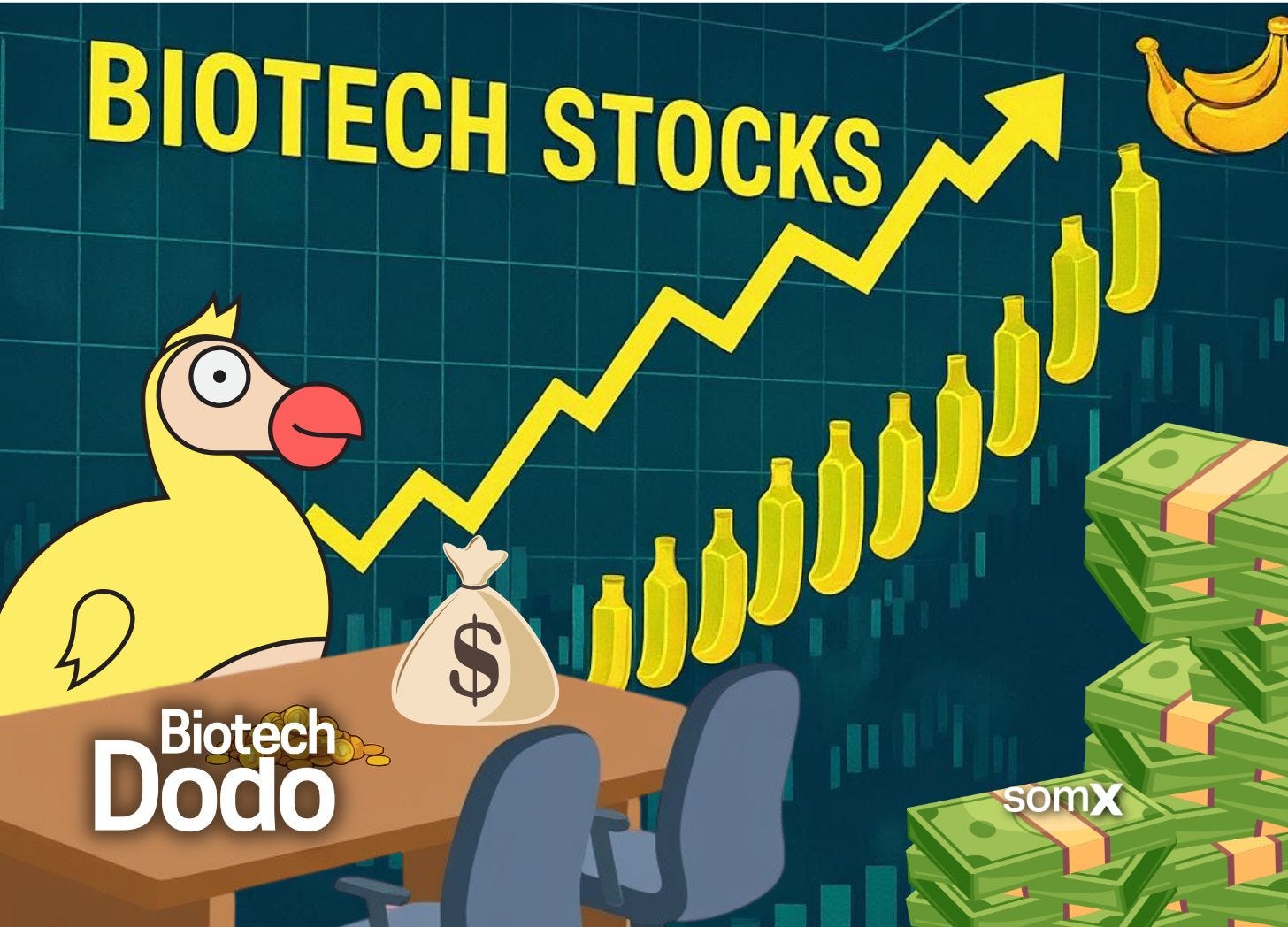
Good morning, my selfish simians,
This week, China’s biotech boom has gone full Planet of the Apes, electric brain shocks could curb our selfish streak and boost empathy, and new findings reveal consciousness lingering for hours after cardiac arrest. Meanwhile, AstraZeneca has announced a bumper multibillion-pound investment in China, and market optimism is returning to UK biotech despite a tricky 2025.
Until next week,
Dodo
If there’s anything you’d like to see in future editions of Biotech Dodo, send us a message.
Discover 🔍
🐒 China’s biotech boom sends price of lab monkeys for drug tests climbing (SCMP): China’s biotech gold rush is monkeying with primate prices. Lab monkeys now fetch 140,000 yuan ($20k) each – more than the average annual salary – doubling in five years amid blockbuster licensing deals and revived funding. However, with 70% of drug-development costs associated with late-stage trials, costly animal models should not make medicine bills go bananas.
Our take: High demand and limited supplies through 2026 have prompted CROs, like WuXi AppTec and Joinn Laboratories, to acquire monkey farms and land in Florida for quarantine facilities – creating resilient, self-sufficient primate supply chains. These structural changes hedge against price volatility and shortages, positioning them as dominant players in global preclinical services. Another upside: owned supply chains could potentially lock in cost advantages and enable faster trial timelines for domestic biotechs.
⚡ Can a pulse of electricity to the brain make us less selfish? (BBC News): University of Zurich scientists zapped 44 volunteers’ frontal and parietal brain zones with mild electric pulses, coaxing them to share more with strangers in a split‑the‑cash game. Syncing empathy and decision circuits delivered consistent, if modest, altruism boosts. The findings highlight a neural mechanism behind generosity and point to potential targets relevant to social dysfunction. However, whether repeated sessions could produce lasting effects remains an open question.
Our take: While the behavioural shift was subtle and short-lived, the study does something more interesting than simply making people “nicer”. By enhancing gamma synchronisation between frontal and parietal regions, the researchers increased how much others’ outcomes influenced participants’ decisions. That makes this less about flicking an “empathy switch” and more about modulating the neural circuitry that integrates self and other interests in real time.
🇨🇳 AstraZeneca to invest US$15bn in China manufacturing and R&D (The Chemical Engineer): AstraZeneca’s expansion dovetails with UK Prime Minister Keir Starmer’s China visit, forging deeper UK-China trade ties through partnerships with Cambridge, Oxford, and King’s College London universities. This structural linkage funnels Chinese manufacturing scale and clinical trial speed into British-led R&D, creating a trans-national pipeline for cell therapies and oncology drugs that bolsters AstraZeneca’s global portfolio, while supporting thousands of UK jobs in life sciences.
Our take: The investment amplifies synergies between China’s CAR-T/stem cell trial dominance and AstraZeneca’s radioconjugates expertise, fostering hybrid modalities like radiolabeled cell therapies for precision oncology. This partnership could yield breakthrough therapy combos unfeasible elsewhere, helping the company diversify beyond traditional small molecules and fortifying their edge in a crowded next-gen cancer market, while aligning with China’s push for indigenous innovation leadership.
🧠 Consciousness could last hours after ‘death’ (The Times): It seems that death is more a dimmer switch than an off button, with brain activity and awareness lingering “minutes to hours” after cardiac arrest, according to research from Arizona State University. Lingering brain activity makes exact time of death difficult to declare, with ramifications for transplantation led by the dead-donor rule. This, and near-death survivors’ experiences, is prompting calls to reconsider CPR duration, adopt “stages of death” protocols, and rethink organ harvest timing.
Our take: Shifting death from a binary “off switch” to staged phases risks complicating transplant practice, consent frameworks and hospital end-of-life structures. And extended CPR, driven by evidence of “elements of consciousness” and electrical signals post-arrest, could impose resource strains on emergency medicine. This persistent consciousness demands rethinking sedation, analgesia, and bedside dignity to ensure humane care in vulnerable final moments.
And finally….
📈 Number of UK biotech companies rising, says report (pharmaphorum): Analysis from Knight Frank reveals the biotech sector has expanded by 22% since 2019, with the UK now home to over 15,000 companies. While growth cooled in 2025 amid economic uncertainty and a drop in venture funding, optimism is rebounding as investor confidence improves. The golden triangle of London, Oxford and Cambridge remains the powerhouse for innovation – boasting record-high lab construction – yet the North West is now outpacing the South East for new start-ups.
Our take: Ey ‘Up! Government incentives tailored specifically for regions outside the Golden Triangle, such as targeted tax breaks and R&D grants in the North West, appear to be accelerating the development of new companies. This decentralised approach is narrowing the traditional north-south divide in life sciences, which could go on to foster a more balanced UK biotech ecosystem that leverages local economic strengths.
Tune in 🎧
🔬 Company turnarounds and AI for infectious diseases with Seek Labs’ Jared Bauer: Cofounder and CEO Jared Bauer shares his journey through biotech turnarounds and how Seek Labs is merging AI, diagnostics and CRISPR-based therapeutics to tackle infectious diseases.
🦀 A strategic turn from obesity to cancer: CEO Amy Burroughs discusses leading Terns Pharmaceuticals through a pivotal transformation, from metabolic disease to oncology, with a novel allosteric BCR‑ABL inhibitor for chronic myeloid leukaemia.
🩸 A Plasmid-Based Cancer Therapy – Dr Alexander Schneider: Founder and CEO Dr Alex Schneider joins Dr Kevin Folta to unpack the evolution from chemotherapy to immunotherapy, spotlighting CureLab’s plasmid‑based therapy, Elanogen, for refractory cancers.
Apply ✍️
📋 Validation Specialist, Kedrion Biopharma UK: Looking to build your career in a GMP‑regulated lab? In this role, you’ll perform analytical testing, maintain documentation to quality standards, and help ensure smooth daily lab operations.
💊 Director of AI/ML Drug Development, Quotient Sciences: Ready to drive digital innovation in Translational Pharmaceutics? You’ll lead the creation of an AI/ML‑enabled drug development function, implementing advanced tools to enhance decision‑making, scientific excellence, and the design and delivery of future medicines.
🧑🔬 Bio Processing Associate - Manufacturing, Leica Biosystems: Want to help advance cancer diagnostics from lab to life? You’ll support manufacturing through scientific expertise, ensuring high‑quality product production and smooth transfer of new innovations.
RSVP 📆
🧫 23.02 | 5th Crick Rare Diseases Conference 2026 | London, UK: An annual meeting uniting clinicians, scientists, and industry experts to share insights, advance understanding, and explore new approaches to diagnosing and treating rare diseases.
🤝 23-27.02 | Biotech Digital Partnering | Online: Five days of global online partnering for pharma, biotech, medtech, and digital health companies – featuring pre‑arranged one‑on‑one Zoom meetings to drive business development and licensing opportunities.
👩🏻💻 27.02 | Innovation in Women’s Health and Femtech | London, UK: Explore breakthroughs in women’s health technology, digital tools, and data strategies to improve patient outcomes and integrate innovative solutions into clinical practice.
Got news, jobs or events you think are worth coo-ing over? Post an event here, or email us at biotechdodo@substack.com!

We’re SomX – a communications and creative agency trusted by biotech, pharma and healthtech pioneers. We craft strategy, content, PR and design that translate complex biology into compelling stories and investor‑ready excitement. Get in touch to amplify your science beyond the lab bench.