


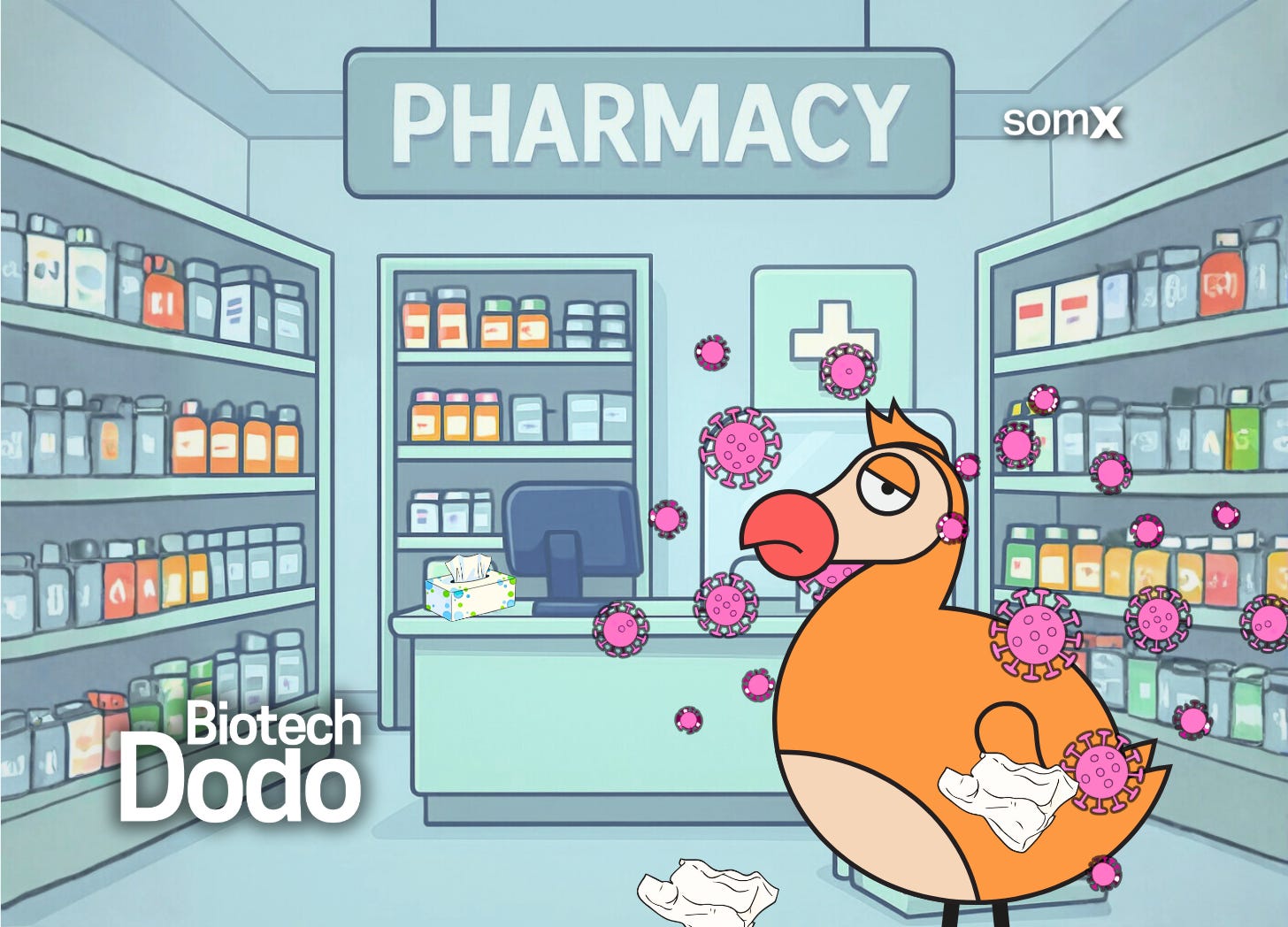
Aitchoo!
Apologies, Dodo has a bit of a cold this week, and it seems like the industry is a little blocked up too. Synthetic viruses are being assembled under tight lab arrest, a former CEO discovers that prison is the ultimate non-compete clause, Duchenne gene therapy remains stuck behind a wall of durability questions, the sinusitis pipeline is congested with biologics, and quantum mechanics expands into protein engineering.
Take care,
Dodo

If you’d like to sponsor a future edition of Biotech Dodo, send us a message.
Discover 🔍
🦠 Antibiotic resistance combatted by fully synthetic bacteriophage assembly (GEN): Researchers from New England Biolabs and Yale have developed a Golden Gate assembly platform that engineers bacteriophages synthetically from sequence data, rather than relying on natural phage isolates. Using the technique, the team assembled a P. aeruginosa phage from 28 synthetic DNA fragments – with programmed modifications including swapped tail fibre genes to alter host range, and fluorescent markers to visualise infection in real time.
Our take: Regulators are going to have an interesting time figuring out what box this fits into. The FDA’s existing phage guidance assumes you found something in nature and maybe changed a gene or two – nobody has written the rules for programmable phages yet. Before this gets anywhere near patients, regulators will need to define what manufacturing quality, comparability, and control even mean when the therapy itself is software-defined biology.
⛓️ CytoDyn’s former CEO gets jail time, $5.3M+ fine for securities fraud (BioSpace): Nader Pourhassan, who ran the company for nearly a decade, has been sentenced to 30 months in prison for misleading investors about leronlimab, an antibody for HIV and COVID-19. Between 2018 and 2021, he overstated trial results, inflated the company’s share price, and sold 4.8M shares for $4.4M. Leronlimab failed its Phase 3 COVID trial in March 2021, despite being publicly described by Pourhassan as delivering “the best results ever achieved for this population.”
Our take: This all unfolded at the height of pandemic urgency, when data was thin and scrutiny lagged behind hope for a COVID cure. Prosecutors said Pourhassan “exploited a deadly public health crisis to intentionally deceive investors,” and the jury agreed. While the sentence sends a message, 2.5 years feels like a light price for the millions taken. More broadly, this shows how quickly optimism can outrun evidence when a system is under pressure, and how slowly accountability follows.
🧬 Sarepta touts three-year Duchenne gene therapy data after patient deaths rattled field (Endpoints): Patients treated with Elevidys showed a 4.39-point improvement on motor skills versus an external control group in Sarepta’s EMBARK study. The children were around nine years old at dosing, an age when patients’ decline typically begins to accelerate. The readout arrives after a rough year for the programme, after two liver failure deaths in non-ambulatory patients led to the therapy being removed from that population. Shares jumped 12% in reaction to the new data, but remain down roughly 80% over the past year.
Our take: For families considering a one-time gene therapy with real safety risks, durability is often the deciding factor. With Elevidys now restricted to ambulatory patients, Sarepta has to prove that benefit in younger boys is not just measurable, but lasting enough to justify hepatotoxicity concerns. For a disease with no cure and limited treatment options, sustained function over time could turn risk into a considered decision rather than a leap of faith.
🤧 A clearer path to relief: sinusitis treatments on the way (Labiotech): After years of steroids and surgery, the sinusitis pipeline is now congested with monoclonal antibodies. Dupixent is lining up for a ninth indication after Phase 3 data showed a 50% improvement in congestion, Tezspire won approval in October, and GSK’s depemokimab is awaiting a regulatory decision following positive Phase 3 data. Even earlier-stage candidates like Upstream Bio’s verekitug are causing a little hullabaloo (bless you!), reducing surgery and steroid use by 76% in Phase 2 trials.
Our take: Reducing steroid dependency is a clear win for patients, but biologics cost 50–100x more than the drugs they are replacing. The economics only stack up if they meaningfully cut surgery rates, hospital visits, and the downstream costs of managing steroid-related harm. That cost reality is why payers remain cautious about expanding access beyond the most severe cases. The clinical benefits are real, but that doesn’t automatically make them affordable at scale.
And finally…
⚛️ Quantum-enabled proteins open a new frontier in biotechnology (Phys.org): Oxford researchers have engineered fluorescent proteins that interact with magnetic fields and radio waves through quantum mechanics – yes, quantum effects happen inside biological molecules too! These magneto-sensitive proteins are the first biomolecules deliberately designed to harness quantum mechanics, allowing scientists to track specific molecules or gene expression inside living organisms, with potential uses in targeted drug delivery and tumour monitoring.
Our take: Most people think quantum usually lives in physics labs, not inside proteins. Instead of trying to design quantum sensors from scratch, the researchers leaned on directed evolution and let biology find workable solutions. The result is a way to track molecular activity inside living systems without bulky imaging hardware. Sitting at the confluence of biology, quantum physics and AI, this work marks a shift from speculative theory to practical tools.


Succeeding in an industry under pressure
60% of biopharma firms are missing market share goals. Find out why, and learn what leaders are doing to deliver.
Tune in 🎧
🧬 Superbabies?: The ethics of prenatal genetic testing are examined through a philosophical lens, focusing on parental decision-making and the limits of genetic foresight.
💉 Vaccines: Does Europe Do Them Better?: The US changes to routine childhood vaccine recommendations are examined alongside Denmark’s model, with expert insight on public health impact and vaccine confidence.
🚀 Speeding China’s Innovation. Plus: Neuro Catalysts and Newcos: The episode looks at China’s new CGT trial rules, neurology milestones to watch, and emerging CNS startups using whole-brain models and neuroplasticity.
Apply ✍️
💻 Full Stack Engineer, Apoha: Keen to build software that talks to real machines? You’ll own core systems behind the Liquid Brain®, shaping slick interfaces, backend services, and hardware control while working hands-on with scientists and devices.
🤖 Director of AI/ML Drug Development, Quotient Sciences: Ready to steer AI into real drug decisions? You’ll lead AI-driven programmes, guide multidisciplinary teams, and embed machine learning into how medicines are designed, tested, and scaled.
🩸 Scientist I/II, Bioconjugation, Abzena: Love turning antibodies into precision tools? You’ll design and run bioconjugation experiments, build ADCs, analyse your own data, and present results to teams and clients.
RSVP 📆
😷 2-5.02 | SCOPE Summit 2026 | Orlando, USA: Now in its 17th year, SCOPE unites the global clinical research ecosystem for four days of strategy, innovation, and networking.
🥼 7-11.02 | SLAS 2026 | Boston, USA: The SLAS International Conference and Exhibition is the premier annual gathering, bringing together the global life sciences and laboratory automation community for a leading showcase of discovery, innovation, and technology.
🍻 12.02 | Biotech & Beers 2026 | Edinburgh, UK: An agenda-free networking evening hosted by Bionow, bringing together life sciences professionals for informal conversations, community building, and a drink or two.
Got news, jobs or events you think are worth coo-ing over? Post an event here, or email us at biotechdodo@substack.com!

We’re SomX – a communications and creative agency trusted by biotech, pharma and healthtech pioneers. We craft strategy, content, PR and design that translate complex biology into compelling stories and investor‑ready excitement. Get in touch to amplify your science beyond the lab bench.
Nice round-up — Quantum-enabled proteins sounds very cool!
On the sinusitis biologics, what do you think has to change for these drugs to be affordable at scale?