


Hello, my fellow master builders,
This week: Cambridge scientists are growing miniature human organs from NHS patients’ own cells, AI has drawn up a 766-gene blueprint for schizophrenia risk, CytoDyn’s leronlimab helps clear HIV from infant macaques, Tenax’s oral levosimendan comes apart in phase 3, and Stanford researchers assemble 16 working viruses from scratch to take on drug-resistant bacteria.
Mind how you go with those blueprints!
Dodo
If you’d like to sponsor a future edition of Biotech Dodo, send us a message.

Treat yourself: biotech edition
The next leap in advanced therapies moves the production of medicines into the cell. What could that mean for patients?
Discover 🔍
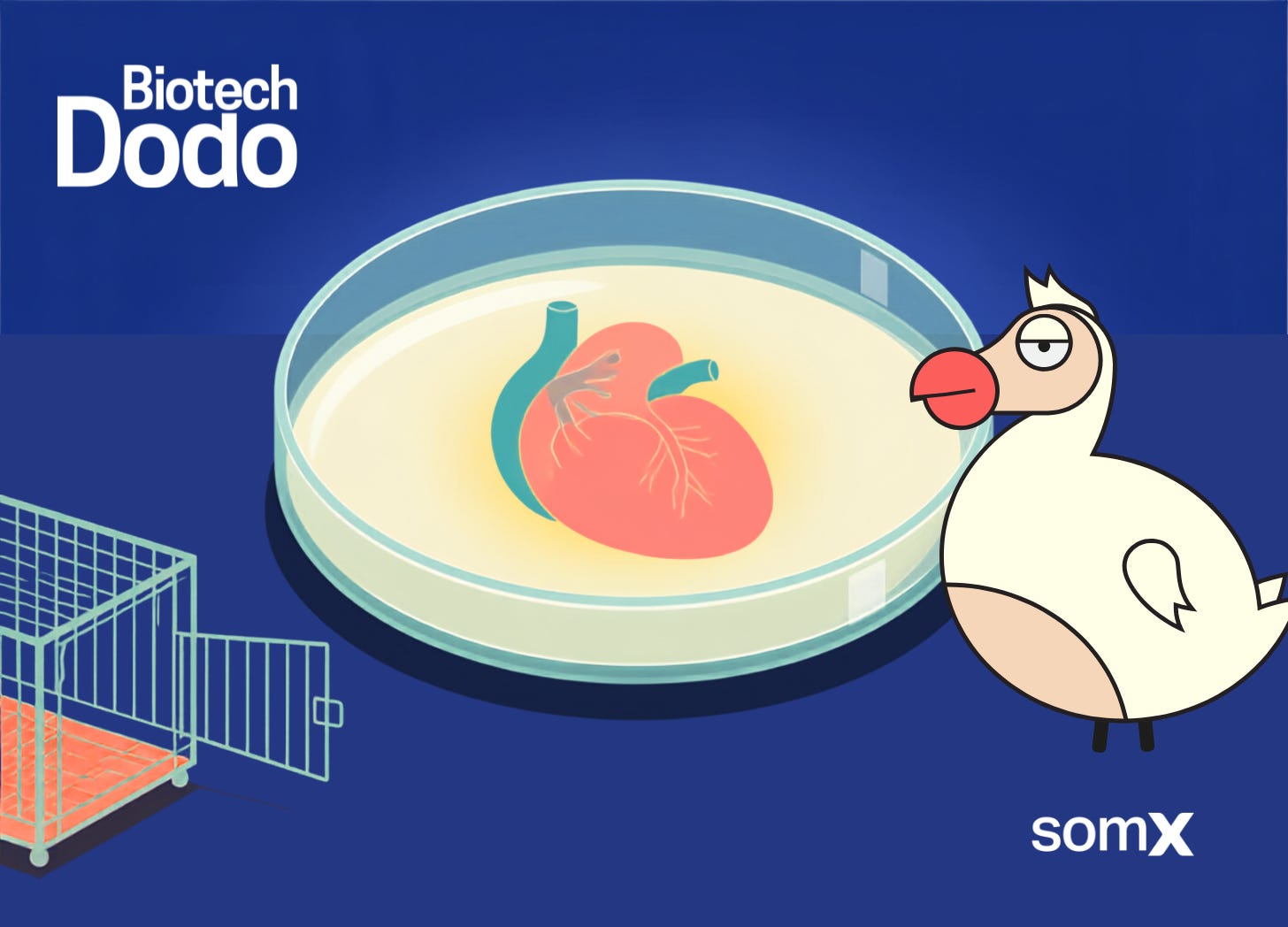
🐭 ‘A mouse can’t tell us what works’: UK scientists to grow miniature human organs for drug testing (The Guardian): A new £20m Cambridge-led project will grow human organoids (tiny clumps of tissue) from NHS patients’ cells to make drug testing more accurate, personalised and less reliant on animals. The models will mimic diseases – including Crohn’s, ulcerative colitis, cancer and neurological conditions – to help researchers test whether a candidate works in all patients or only a subset. The project aims to create a standardised library of validated models for academics and industry.
Our take: More than 90% of drugs that clear animal testing still fail in human trials, so the case for organoids is not only about using fewer animals; it is that the current system tests the wrong species. Patient-derived organoids are valuable precisely because they capture biological differences between individuals, so the challenge is to standardise how they are grown and tested without flattening the genetic, cellular and disease variation researchers are trying to study.
🧠 AI is helping solve the intricate genetic puzzle of schizophrenia (Wired): Scientists have identified 766 genes linked to schizophrenia, including 641 not previously highlighted in transcriptome-wide studies, using AI-based computational models which capture long-range regulatory relationships. The Nature Genetics study drew on genetic data from over 102,000 people and brain tissue from six regions, suggesting schizophrenia risk builds through coordinated gene networks rather than single faulty genes. The findings could help explain why symptoms vary so widely between patients. (Editor’s note: the Nature Genetics paper was published in June.)
Our take: The clinical value of maps like this will depend on how representative the underlying data is. Psychiatric genomics has historically overrepresented people of European ancestry, and the co-expression networks that make this method work are themselves learned from brain tissue donors who skew the same way. Polygenic findings already transfer less accurately to other populations and without broader ancestry and environmental representation, the technology could deepen, rather than reduce, health inequalities in risk prediction and treatment selection.
🐵 CytoDyn’s leronlimab reaffirms HIV potential after combo treatment eradicates virus in infant macaques (Fierce Biotech): CytoDyn’s leronlimab has helped eradicate HIV in infant macaques, treated within 72 hours of infection, when combined with antiretroviral therapy and two broadly neutralising antibodies. All eight animals on the triple regimen showed no viral rebound for up to a year after treatment stopped, while individual therapies and simpler combinations failed to prevent the virus from establishing itself. Leronlimab blocks CCR5, the co-receptor HIV uses to enter immune cells, while the other therapies attack the virus directly.
Our take: Given that every combination without leronlimab failed, the macaque results make a strong case that CCR5 blockade is doing something the other drugs cannot. What they cannot yet show is how far the 72-hour treatment window stretches, or whether it exists at all in adults. Future trials will need to establish that while still protecting participants from being assigned an inferior regimen, which creates a difficult trial-design and regulatory problem for HIV-cure research.
🫀 Tenax trounced by phase 3 heart failure readout (pharmaphorum): Tenax Therapeutics’ shares fell more than 85% this week, after its phase 3 LEVEL trial missed both its primary and key secondary endpoints. TNX-103, an oral version of the calcium sensitiser levosimendan, failed to improve how far patients could walk, or their symptom scores, compared with placebo. The target was pulmonary hypertension caused by a stiff heart, a condition with no approved treatment – Tenax’s bet was that an oral levosimendan, long used intravenously in Europe but never approved in the US, could fill that gap.
Our take: Levosimendan works by helping the heart squeeze harder, but in this condition the squeeze was never the problem; the heart pumps fine, it just won’t relax enough to fill properly between beats. Tenax says the trial enrolled too many patients with mild disease, and it wants regulators to let it revise its approach. However, the more likely explanation is that a contraction drug was never going to fix a stiffness problem, whatever state the patients arrived in.
And finally…
🦠 Sixteen AI-designed viruses offer a new route against drug-resistant bacteria (phys.org): Stanford-led researchers have crossed a significant threshold in generative biology, using AI to design complete viral genomes that can function in living cells. Of 285 synthesised candidates, 16 produced viable viruses capable of infecting and killing E. coli; a cocktail of these synthetic phages went further, killing bacterial strains that had already evolved resistance to the natural virus they were modelled on. The work points towards custom-designed viruses as a new weapon against drug-resistant bacteria. (Read the Science paper)
Our take: A major advantage of AI-designed phages could be their ability to respond as bacteria evolve resistance. That creates an unusual, but important, regulatory problem: conventional drug approvals assume a relatively fixed therapeutic product, while an effective phage platform might need to repeatedly update its viral components. Regulators may eventually need a framework closer to platform or strain-update approvals than a traditional drug-by-drug assessment.

Tune in 🎧
🇨🇳 Why Western pharma is sleeping on China’s circular RNA revolution: Therorna’s founder makes the case for circular RNA over linear mRNA, arguing it offers greater stability, durability and the ability to be re-dosed.
🤖 AI-Designed Viruses, OpenAI’s First Device, The Mansion Section: TBPN covers the synthetic phage paper, a forthcoming OpenAI hardware device, and Meta’s child safety case, with guests from Khosla Ventures, Databricks and the live-shopping platform Whatnot.
🧬 Cell therapy advances and biotech leadership with Nkarta’s Paul Hastings: Nkarta’s CEO on an off-the-shelf CAR NK approach to autoimmune disease, and why US clinical trial infrastructure is holding cell therapy back.
Apply ✍️
🎩 Head of Life Sciences, London & Partners: Experienced in strategy, investment and cluster development? This leadership role will involve shaping London’s life sciences growth strategy and building relationships across industry, government, healthcare and research.
⚙️ Senior Project Engineer, Cytiva: Got a track record of delivering manufacturing projects on time and under budget? You’ll lead cross-functional teams, drive continuous improvement initiatives, and validate new equipment running to Medical QMS standards.
🫡 Senior Director, Market Strategy and Development, Thermo Fisher Scientific: Interested in commercial strategy, demand generation and biopharma markets? This senior leadership role will set global go-to-market direction across Thermo Fisher’s CDMO portfolio.
📊 Senior Manager, RWE/Epidemiology, Pfizer: Got a knack for wringing insights from real-world data? You’ll design epidemiological studies across Pfizer’s internal medicine pipeline, author regulatory submissions, and build external data partnerships.
RSVP 📆
🧬 20-21.08 | 15th International Conference on Biotechnology | London, UK: Explore advances in genetic engineering, tissue engineering, microbial biotechnology, biofabrication, nanobiotechnology and pharmaceutical innovation.
💡 24.08 | BioTech Startups, Investors, Innovators & Professionals Networking Event | London, UK: An evening bringing together biotech founders, investors, researchers and industry professionals to build connections, share ideas and explore new opportunities for collaboration across biotechnology and life sciences.
🤝 01-02.09 | Asia Bio Partnering Forum | Singapore: Asia-Pacific’s flagship dealmaking gathering, now in its fourth year, bringing 650+ pharma, biotech and investor attendees to Marina Bay Sands for 2,500 one-to-one meetings and 300+ licensing opportunities.
Got news, jobs or events you think are worth coo-ing over? Post an event here, or email us at biotechdodo@substack.com!

We’re SomX, a communications and creative agency trusted by biotech, pharma and healthtech pioneers. We craft strategy, content, PR and design that translate complex biology into compelling stories and investor-ready excitement. Get in touch to amplify your science beyond the lab bench.