


Welcome to those still standing,
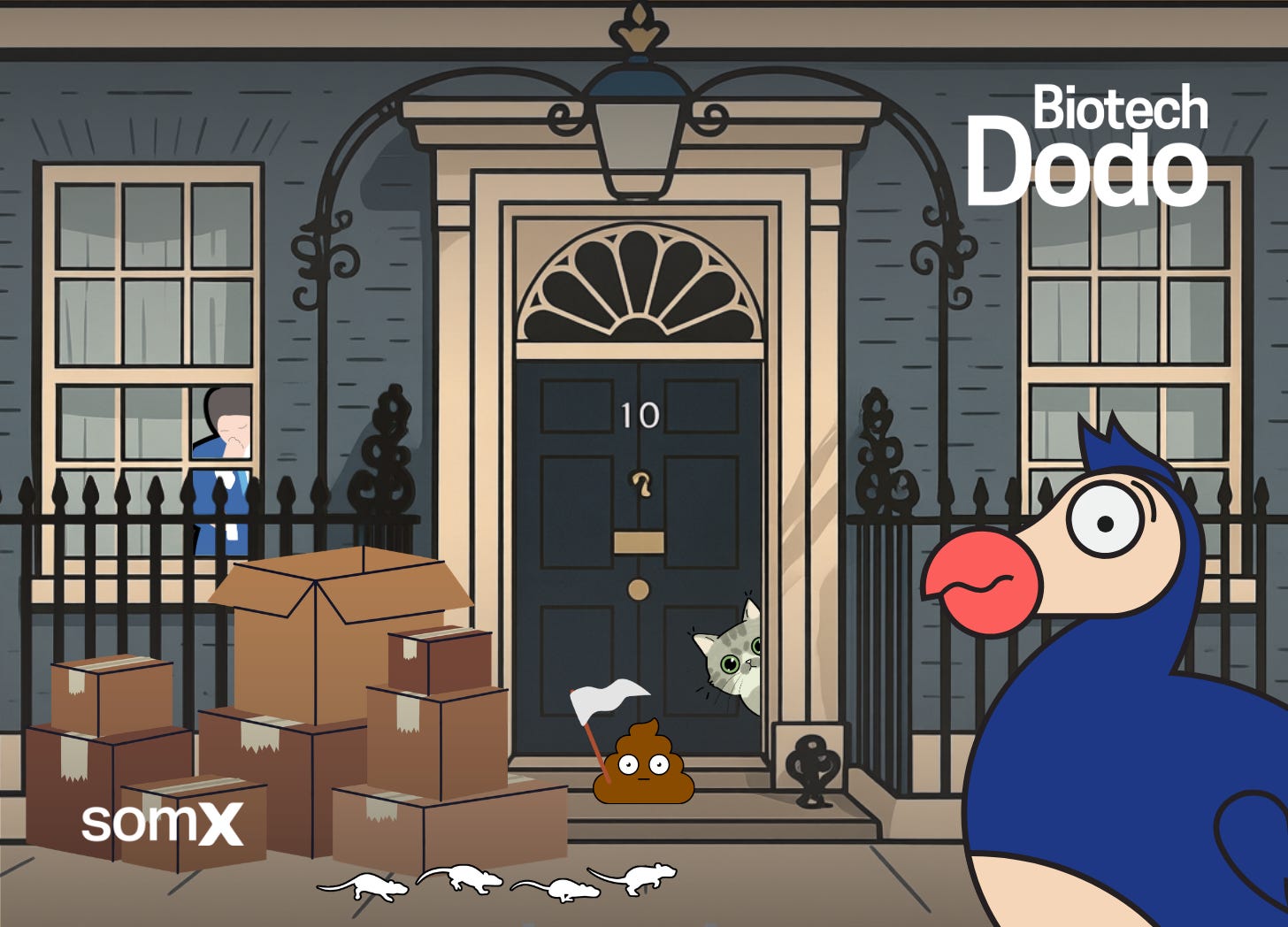
This week, Keir Starmer isn't the only one having a bad time: one of Oxford's brightest biotech hopes has been dragged into liquidation, a French startup is waving the white flag on severed nerves with a clever goo, RQ Bio has surrendered to the seasonal flu grind with a long-acting antibody, a new eye drug could make dreaded eyeball injections a far rarer event, and old mice are staging a small rebellion with youthful gut bacteria.
Surrender accepted,
Dodo
If there’s anything you’d like to see in future editions of Biotech Dodo, send us a message.
Discover 🔍
📈 Record-breaking UK biotech firm in near £3 million collapse (Oxford Mail): How the mighty have fallen. OxStem Limited, a once high-flying Oxford biotech, backed by a then-record £16.9m spinout investment, has collapsed in a complex liquidation battle. The company, which aimed to tackle ageing-related diseases such as cancer and Alzheimer’s, was still seeking funding for clinical trials as recently as 2019, before financial trouble set in. Liquidators were appointed in 2022, but the winding-up remains unresolved.
Our take: A headline-grabbing cheque does not always buy survival. The University of Oxford – which spun OxStem out, supplied its founding science and championed its record investment – now sits as a creditor, chasing more than £3m from its own creation through arbitration. Oxford is on every side of the table at once (founder, backer and claimant), a tangle that is precisely why the liquidation has dragged on for three years with no end in sight.
🤕 A startup is using special polymers to better help nerves heal (Wired): French startup Tissium has developed a biodegradable goo that might help severed nerves knit back together after surgery. Made from fatty acids and glycerol, the material acts as a temporary splint, holding damaged nerves steady while the body sets about its own repairs. In a US trial of 12 patients with finger nerve injuries, all who completed follow-up regained the ability to feel temperature, pain, texture and light touch, vs a meaningful recovery rate of just 54% for the sutures it would replace.
Our take: A clean run across the patients who completed the trial is a charming result on a thin evidence base. The commercial test will be whether better sensation and fewer complications are achieved in larger, more diverse patient groups. A 200-patient US hernia trial and an upcoming cardiovascular pivotal trial will be the real proving ground for the polymer platform; surgeons and hospitals, quite understandably, will want consistency at scale before reaching for the goo.
🤧 RQ Bio raises $115m for long-acting flu antibody (European Biotechnology Magazine): The London-based company has raised a hefty Series A to push RQB01, a long-acting flu-prevention antibody, towards the clinic. Backed by life sciences investors and LifeArc Ventures, the firm’s vision is to develop a single jab to shield vulnerable patients for a whole season. RQB01 targets conserved parts of the virus that do not change year to year, the idea being that one shot covers broad strains where vaccines alone fall short.
Our take: RQ Bio is chasing a narrow target: vulnerable patients whose immune systems cannot mount an adequate response to a vaccine. The trouble is, everyone else is chasing it too. Better mRNA vaccines, rival antibodies and nasal sprays like Leyden Labs’ are all converging on the same small group. RQB01’s pitch is one jab for a whole season, but it has to prove that the gap is wide enough to justify this much capital.
👀 Ollin refuels with $330M to back pivotal tests of Vabysmo challenger (BioPharmaDive): Ollin Biosciences is pushing ahead with its lead eye disease drug OLN324 into pivotal trials, in one of biotech’s biggest venture rounds of the year. The antibody is being lined up as a challenger to Roche’s Vabysmo, which racked up around $5B in 2025 after less than four full years on the market. Early data hints that OLN324 may prove more potent and longer-lasting than the incumbent.
Our take: Beating Vabysmo on raw efficacy is not the prize Ollin is chasing. The real game is to change the treatment calculus for diseases in which patients currently endure repeated jabs into the eyeball over many years. If OLN324 can meaningfully extend durability, the real value will lie in reducing clinic capacity pressure, patient burden and long-term treatment fatigue.
And finally…
💩 Faecal transplant makes the brains of old mice act young again (The New Scientist): Transplanting gut microbiomes from younger animals has been shown to boost brain plasticity, enhancing the brain’s ability to remodel itself and form new connections. Treated mice exhibited responses similar to young animals, suggesting their brains had regained some adaptability. Additionally, the study revealed that disrupting the microbiome in young mice with antibiotics affected more than 1,000 genes in the visual cortex.
Our take: Brain plasticity has always been considered fixed after childhood. If the gut microbiome really does govern this adaptability, early-life antibiotics and diet may matter more than appreciated. Faecal transplants may be a crude starting point, but the implications run deep: disorders currently written off as untreatable after childhood – like amblyopia, or lazy eye – might not be so permanent after all.
Tune in 🎧
🧑🔬 BIO International Convention 2026: Former Evotec CEO Werner Lanthaler explains why BIO is the industry’s most important partnering forum, and shares practical, hard-won advice for biotechs.
🧪 Keeping an early-stage cell therapy biotech in the black with IN8bio’s William Ho: A candid, step-by-step account of financing a gamma delta T-cell company through a tough IPO market and prolonged cash constraints.
🔥 A pipeline in a product that reimagines control of inflammation: BioAegis CEO Susan Levinson discusses recombinant human plasma gelsolin as a potential first-in-class therapy for ARDS and other inflammasome-driven diseases.
Apply ✍️
🧬 Business Development Manager, Biocytogen: Ready to bridge science and dealmaking in biopharma? You’ll combine deep scientific expertise with commercial acumen to source opportunities, lead negotiations, and represent the company at global conferences.
🔬 Senior Scientist, Evotec: Interested in leading complex biologics programmes from design to delivery? You’ll drive antibody and protein engineering projects end-to-end, overseeing experimental strategy, high-throughput workflows, and data quality.
🦀 Clinical Study Lead, In Vitro Diagnostics, QIAGEN: Passionate about driving global studies for precision oncology diagnostics? You’ll lead full clinical performance programmes, designing protocols, managing cross-functional teams and sites, and delivering regulatory submissions.
RSVP 📆
🕶️ 02.07 | BIA Summer Party | London, UK: Join the sector’s finest for an unforgettable evening of cocktails, canapés, and high-level networking. Whether you’re looking to connect with peers or showcase your brand, the Summer Party offers the perfect setting.
💡 04-08.07 | 50th FEBS Congress | Maastricht, Netherlands: A landmark gathering in molecular and cellular life sciences featuring Nobel laureates and global research leaders, with plenary lectures and 17 symposia showcasing the latest discoveries across the field.
🥼 09.07 | Disrupting Bio Innovation | Cambridge, UK: Explore the breakthrough technologies, policies and business models reshaping drug discovery, with a focus on translating cutting-edge research into diagnostics and treatments.
Got news, jobs or events you think are worth coo-ing over? Post an event here, or email us at biotechdodo@substack.com!

We’re SomX – a communications and creative agency trusted by biotech, pharma and healthtech pioneers. We craft strategy, content, PR and design that translate complex biology into compelling stories and investor‑ready excitement. Get in touch to amplify your science beyond the lab bench.